Quick Bites (TL;DR)
- Trading Debt vs. Trading Assets: Conventional banks sell money for money (interest). Islamic banks trade physical assets or share actual business profits.
- Risk Sharing: In the Halal system, both the bank and the customer share the risk. You are a partner, not just a borrower to be squeezed.
- Zero Haram Investments: An Islamic bank guarantees your deposited funds will never be used to finance alcohol, gambling, or destructive industries.
Every time you deposit a paycheck into a standard savings account, you might unknowingly be funding businesses that directly contradict your Islamic faith.
Conventional banks take your hard-earned money and lend it out at high interest rates. They keep the massive profits and hand you a tiny fraction, exposing your entire household to the sin of Riba.
To truly protect your family, you must master the core complete guide to Halal finance principles. The fundamental difference lies in how money is viewed. In Islam, money is just a medium of exchange. It cannot create more money by simply sitting in an account.
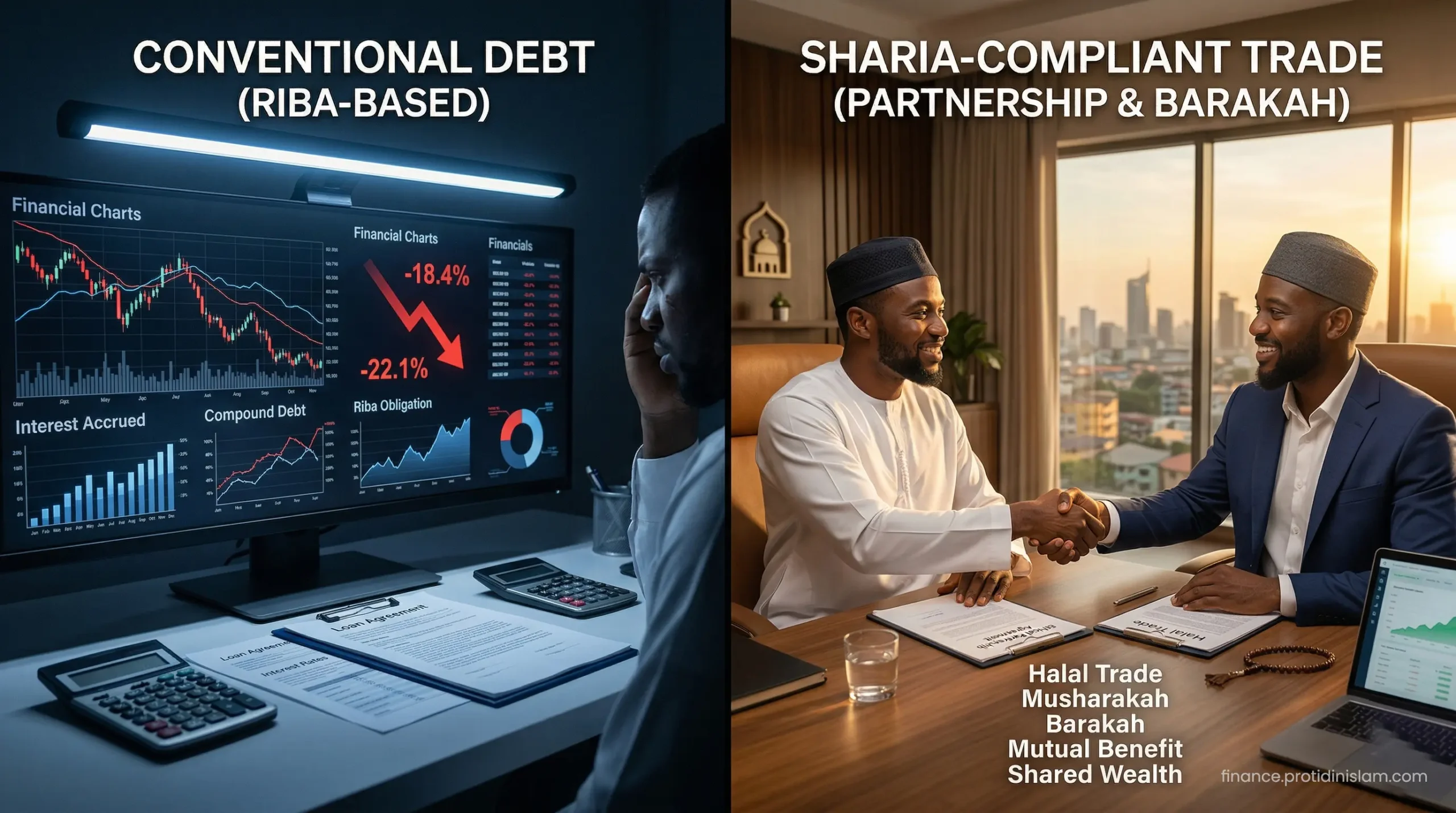
Conventional banking is built entirely on selling debt. Islamic banking is built on trade, leasing, and partnership. When you want to buy a car, a conventional bank gives you cash and charges you interest for the loan.
An Islamic bank physically buys the car first. They then sell it to you at a pre-agreed profit margin. You pay them in installments. This is a pure trade transaction (Murabahah), which is 100% Halal and highly encouraged.
Mizanur’s Halal Finance Hack: The “Contract Word” Test
Many conventional banks try to lure Muslim customers by slapping an “Islamic Window” label on their standard products. You have to be smart and read the actual paperwork.
My favorite trick is the “Contract Word Test”. Take the agreement and search for the word “Loan”. If the contract states they are giving you a “loan” with a “fixed percentage return”, walk away immediately. It is just Riba in disguise.
A true Sharia-compliant contract will use words like “Lease” (Ijarah), “Partnership” (Musharakah), or “Cost-Plus Financing” (Murabahah). The bank must take ownership of an asset at some point to make the profit Halal.

Because Islamic banks share the risk of investments, they are incredibly careful with where they put your money. They actively avoid highly speculative, risky trading that causes global financial crashes.
If you live in Africa and want to secure your funds, switching to the top Islamic banking options in South Africa is the smartest move you can make for your financial and spiritual health.
Once your foundation is clean, you can confidently use your savings to start a Halal business. A pure bank account combined with honest work is a magnet for divine blessings.
Frequently Asked Questions About Banking Systems
1. Do Islamic banks just hide interest by calling it a “profit rate”?
No. While the final amount you pay might look mathematically similar to market interest rates, the underlying contract is entirely different. Islamic banks earn profit by buying an asset and selling it to you at a markup, or by renting it to you. Trade is Halal; charging rent on money (interest) is Haram.
2. What happens if I miss a payment with an Islamic bank?
In a conventional bank, missing a payment triggers compounding interest, making your debt spiral out of control. An Islamic bank cannot charge compounding interest for late payments. They may charge a fixed penalty fee to deter negligence, but Sharia boards mandate that this fee must be donated to charity, not kept as bank profit.
3. Are my deposits safe in an Islamic bank?
Yes. Just like conventional banks, Islamic banks are heavily regulated by national central banks and must adhere to strict liquidity and capital requirements. Because they avoid toxic, highly speculative investments, they are often more stable during economic downturns.